

Empowering our regional communities
Horizon Power offers selected customers a safe and reliable source of electricity through our stand‑alone power system solutions, which are designed to sustainably service end-of-grid customers.
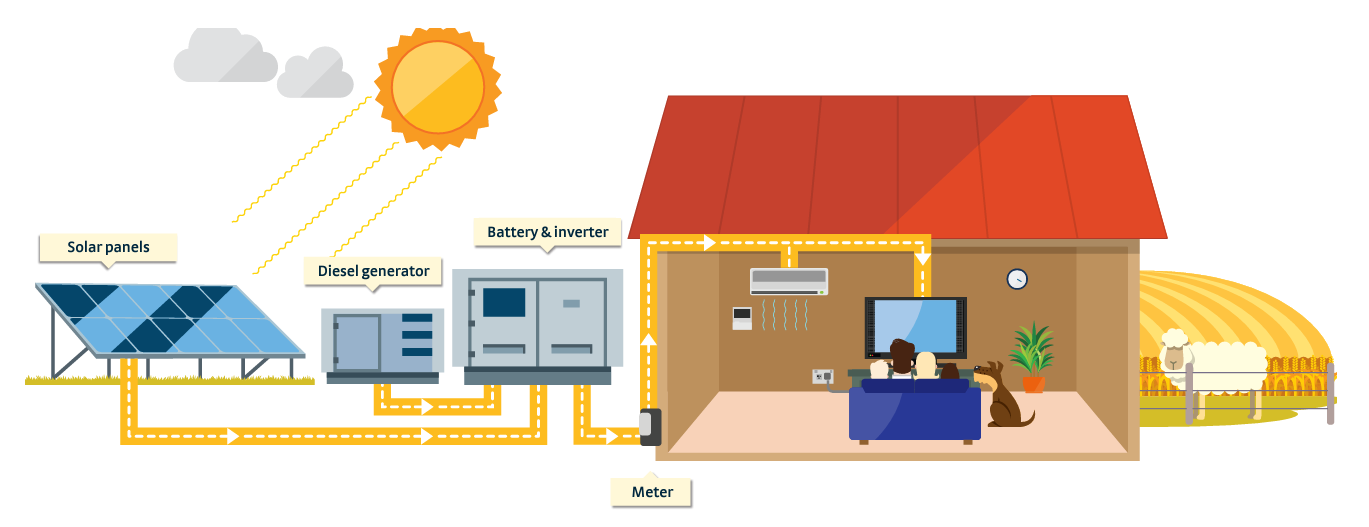
Our stand‑alone power systems use solar and battery technology to generate and store electricity without the need to be connected to the overhead electricity network. Using solar panels, batteries, inverters and in some instances, a back-up generator the system supplies power 24 hours a day, regardless of weather conditions.
How does it work?
Solar panels, battery storage, an inverter and a backup generator all work together at different times of the day to deliver reliable clean power to your property.
- Solar panels are the main source of power and generate electricity when the sun is out.
- Batteries provide power at night and when the sun isn’t shining for long periods of time.
- The low noise back up generator will kick in on occasions when more power is needed than what the solar panels and batteries can provide.

Cleaner and greener
This off-grid solution supports our customers who live and work in remote locations. We take into account the energy usage of each property before customising a system to suit its occupant’s needs.
Not only are these systems cleaner and greener, they’re safer too. With no poles and wires to maintain, they reduce the risk of bushfires and minimise farming hazards.
These units provide better power reliability, quality and safety to some of our more isolated, end-of-grid customers, and help us create a greener WA.

The process
We will contact you if your property has been identified as one that could transition to a stand‑alone power system. Horizon Power identifies this through detailed asset management planning.
Horizon Power will work with you every step of the way. Our goal is to make transitioning to a stand‑alone power system as seamless as possible.
Benefits
Customers supplied via our stand‑alone power systems enjoy access to the same services and protections as our grid connected customers.
Benefits of being supplied by our stand‑alone power systems include:
Improved reliability
Stand‑alone power systems are less affected by outages caused by powerline maintenance, wildlife, severe storms, lightning and bushfires.
Reduced risk
Removing poles and wires eliminates the risk of injury to people, and potential damage to network and property caused by farming activities, while also reducing bushfire risk.
Clean energy solution
Our stand‑alone power systems use hybrid renewable energy technology with a combination of solar panels and batteries that provide a cleaner alternative to electricity generation via fossil fuels.
FAQs
During the day, solar panels supply energy to the property and charge batteries so that power is available when the sun isn’t shining. Batteries provide power at night and during periods of cloudy weather. Some stand‑alone power systems include a back-up generator. The low noise, back-up generator will occasionally run when more power is needed than what the solar panels and batteries can provide, typically during periods of cloudy weather or high energy demand within the property.
Horizon Power identifies opportunities for properties to transition to a stand‑alone power system through its asset management planning. Candidate properties are selected based on the economic merits of replacing existing network infrastructure with a stand‑alone power system.
Customers supplied via a stand‑alone power system pay the same unit price for electricity as they would if they remained connected to the overhead power network.
Horizon Power is responsible for the cost of transition to a like for like connection capacity. Customers may seek a quote from Horizon Power for incremental costs associated with upgrading the capacity of their connection.
Horizon Power is responsible for the costs associated with operating and maintaining the stand‑alone power system.
The stand‑alone power system is owned and operated by Horizon Power.
For the most part, yes. However, this depends on a customer’s location along the power line. If the customer is at the end of the line, they should be able to transition to a stand‑alone power system regardless of whether other customers on the line wish to participate. However, if there are other customers between an individual customer and the end of the line who do not wish to participate, it is unlikely a customer will be able to transition to a stand‑alone power system.
The stand‑alone power system will meet the relevant Australian Standards for its components and installation (for example, AS 3000:2018, AS 4509.1: 2009), including environmental regulations for diesel storage. These systems do not emit any higher electric and magnetic fields (EMF) than common household appliances such as microwave ovens and any EMF emissions will be undetectable within the home.
The stand‑alone power system may come with a new main switchboard including a new meter. If so, the old meter will be removed as part of the connection works. Customers will have access to the new meter, and it will form part of the upgrade works. Alternatively, the existing meter will remain in its current position with a new underground connection from the stand‑alone power system.
The stand‑alone power system will consist of ground mounted solar panels, batteries and if required, a diesel generator. Horizon Power works with customers to determine the optimal configuration of the SPS to maximise solar and battery storage and minimise generator run times if installed.
Systems are sized to provide power equivalent to the existing overhead connection, considering customer requirements obtained through customer engagement, site audits and the analysis of energy data obtained from the network meter. Horizon Power’s standard designs can provide 16 – 60 kW of power and 16 – 200 kWh of energy storage via batteries.
If your property is identified as a potential candidate for a stand‑alone power system we will seek your permission for a site inspection, to identify potential locations for the stand‑alone power system and gather information to finalise a design and layout that meets your needs.
The area required for a stand‑alone power system is approximately 100-250 square metres. The solar panels are ground-mounted, and the batteries will be located inside a cabinet to protect them from weather. The average number of panels is 24 and they are usually stacked in two rows, with 12 per row. However, different configurations can be applied.
Horizon Power will work with customers to identify the most suitable location for the stand‑alone power system, taking into consideration several factors. Most importantly, the location selected should avoid any shady areas to ensure the best operation of the solar panels. Horizon Power also aims to avoid disturbing customer amenity with the location of the SPS and ensure the system can be adequately serviced. Ideally the stand‑alone power system will be located within 100 m of the existing site main switchboard.
It is essential that only authorised Horizon Power contractors undertake any clearing required for the stand‑alone power system. Horizon Power has strict guidelines that align with its commitment to recognising the connections Traditional Owners have to Country and have responsibility to minimise impact on the environment. Customer support to ensure only authorised contactors complete this component of the project is greatly appreciated.
For safety, all Horizon Power stand‑alone power systems will either be fenced to keep livestock out or designed to prevent damage to or from livestock.
Yes. Stand‑alone power systems are less affected by outages caused by powerline maintenance, wildlife, severe storms, lightning and bushfires compared to overhead network infrastructure.
Our stand‑alone power systems are designed to provide at least 80% renewable energy. Some systems may be designed without a back-up generator as they will have adequate battery storage to provide 100% renewable energy. Where a low-noise back-up generator is installed, it may operate a few times a week and run for up to a few hours to recharge the batteries or supply energy to the property.
The back-up generator will emit audible noise when operating, but this will be lower than the relevant State regulations for the intended use. It will produce emissions at levels similar to diesel vehicles on the road. To comply with noise and emission regulations, the back-up generator is manufactured with a low-noise enclosure, and it will be installed at the required minimum distance from buildings.
Our stand‑alone power systems are designed to provide power during extended periods of low sunshine. Batteries are sized to ensure they can meet a customer’s energy needs for a typical 24-hour period without any solar input. If it is overcast for a long period of time, the back-up generator will operate to recharge the batteries. Installations without a generator will have adequate battery storage for extended periods of overcast weather.
Our standard designs are sized to provide power equivalent to the existing overhead network connection, typically ranging from 16 – 24 kW for the replacement of 10 – 25 kVA transformers. These solutions are suitable for the majority of properties in regional and remote WA, providing enough power for several houses, workshops, shearing sheds and outbuildings.
If your energy needs are more complex, we will tailor a design to suit your individual connection requirements.
Customers can request to upgrade the system to meet their future plans, by seeking a quote from Horizon Power. The quote will cover any incremental costs associated with the upgrade.
Transitioning to a stand‑alone power system will increase the reliability of the supply, reducing both the number and duration of outages.
Due to the way the stand‑alone power system works, frequency may vary across the day within the limits of relevant standards. This may cause clocks that run on mains power to be either slightly slow or fast depending upon the time of day.
No, not at all. Once the stand‑alone power system is installed, Horizon Power will take care of maintenance and running costs. Using our remote technology, we will monitor the performance of the system and the reliability of the electricity supply, including the diesel required for the back-up generator (if installed).
Customers can report faults by calling 13 23 51, 24 hours a day.
Horizon Power will remotely monitor the generator’s fuel tank and if it is running low, a local team will be dispatched to refill it.

Did you know?
In 2022, we partnered with Telstra to transition Western Australia’s first remote mobile tower from an overhead power supply to a stand-alone power system (SPS).
The SPS is providing next generation solar and battery technology to generate and store electricity without the need for the tower to be connected to the overhead electricity network, and is being trialled by Telstra in its ongoing efforts to strengthen network resiliency.
Bushfires, floods and cyclones can have a devastating impact on our network infrastructure and off-grid power solutions like this can help keep our communities safe, connected and informed during stressful events.
Horizon Power acknowledges the Traditional Custodians throughout Western Australia and their continuing connection to the land, waters and community. We pay our respects to all members of the Aboriginal communities and their cultures; and to Elders past, present and emerging.
Aboriginal and Torres Strait Islander people are advised that this website may contain images, names or voices of deceased people.